

Dear Passengers Gameplay:
Fly, Serve and Survive
Dear Passengers gameplay connects cockpit decisions with cabin consequences. This independent guide explains the confirmed flight loop, full plane control, passenger service, risky cargo, weather, physics, solo mode, and online co-op without inventing inputs or progression systems.
What Is Dear Passengers Gameplay?
Dear Passengers gameplay is a first-person action-adventure loop about operating an unreliable airline. One crew member flies the aircraft while others serve passengers, protect cargo, and contain emergencies. Before takeoff, the group chooses passengers and cargo with different risks and payouts. In flight, weather, turbulence, air pockets, and physics can turn ordinary work into a shared disaster.
The important idea is connection. Dear Passengers does not present piloting, service, cargo, and weather as isolated minigames. A cockpit correction can move the people and objects behind the pilot. An unresolved cabin problem can force the crew to change priorities while the aircraft is already in trouble. That relationship gives Dear Passengers gameplay its cooperative identity.
Steam currently confirms Windows PC, single-player, and online co-op. It also names dynamic weather, turbulence, air pockets, physics-based passengers and cargo, passenger service, and risk-versus-reward manifest choices. In a July 31 official update, FLEXUS added that players fully control the plane and said a video showing an actual flight is being assembled. Dear Passengers has not launched, so exact inputs, route structure, aircraft selection, scoring, upgrades, matchmaking, and maximum crew size remain outside the confirmed record.
The destination is simple. Everything that happens between the terminal and landing is the game.
The Dear Passengers Gameplay Loop
The public Dear Passengers gameplay description provides a readable sequence even though FLEXUS has not shown every menu. The sequence below is an evidence-based organization of official features, not a claim about final mission screens or mandatory tutorial steps.
- 01
Build the manifest. Choose passengers and cargo before takeoff. Higher payouts are associated with people and loads that may be harder to manage.
- 02
Divide the crew. Put one person in the cockpit while the remaining crew prepares to work inside the cabin.
- 03
Provide service. Passengers expect food, drinks, and something resembling a smooth flight.
- 04
Protect people and cargo. Keep difficult travelers and unstable objects from turning a small incident into a larger emergency.
- 05
React to the aircraft. Weather, turbulence, and air pockets alter what the pilot and cabin workers can safely do.
- 06
Reach the destination. Deliver the selected passengers and cargo, preferably in one piece, while preserving as much control as the flight allows.
Risk begins before the plane moves. The manifest appears to function as an informal difficulty choice: safer passengers and cargo may reduce trouble, while more profitable selections create a greater chance of failure. Dear Passengers gameplay therefore starts with judgment rather than reaction.
The official wording does not reveal how earnings are spent, whether contracts unlock routes, how success is graded, or what happens after a failed flight. Those details matter for a complete strategy guide, but publishing them now would turn a reliable Dear Passengers gameplay guideinto speculation.
Dear Passengers Pilot Gameplay
Piloting is one of the clearest confirmed parts of Dear Passengers gameplay. Steam says one member of the group flies while the others work inside the cabin. Official footage shows a first-person cockpit perspective and external hazards. FLEXUS then stated directly on July 31 that players fully control the plane. That confirms player authority over the aircraft, but the studio has not yet published a finished control manual or an uninterrupted flight from takeoff to landing.
The pilot matters because aircraft movement affects the rest of the crew. Turbulence and air pockets can move passengers, luggage, cargo, and unsecured cabin equipment. Even when the cockpit avoids a larger hazard, a sharp reaction may create immediate cleanup behind the door. Dear Passengers gameplay turns movement into a team decision rather than a private steering task.
Is Dear Passengers a Flight Simulator?
Calling Dear Passengers a realistic flight simulator would overstate the evidence. Steam categorizes the project as action, adventure, and indie, while the public description emphasizes comedy, cooperation, passenger behavior, dangerous cargo, and physical emergencies. Flying is central, but simulator-level navigation, fuel systems, radio procedure, aerodynamic settings, and cockpit authenticity have not been documented.
What Pilot Controls Are Confirmed?
Full aircraft control is now confirmed, but no complete keyboard, mouse, controller, or flight-stick layout is public. FLEXUS has not explained throttle behavior, pitch and roll inputs, landing gear, autopilot, instrumentation, or accessibility assists. A responsible Dear Passengers gameplay page can confirm player control while leaving individual buttons and simulation depth open until a demo, extended gameplay video, or official manual supplies evidence.
FLEXUS says a longer Dear Passengers gameplay video is in production to show an actual flight, but gives no date. The statement confirms player control—not specific inputs, flight handling, landing, failure states, or the final interface. The Dear Passengers news log tracks its release.
Dear Passengers Cabin Crew Gameplay
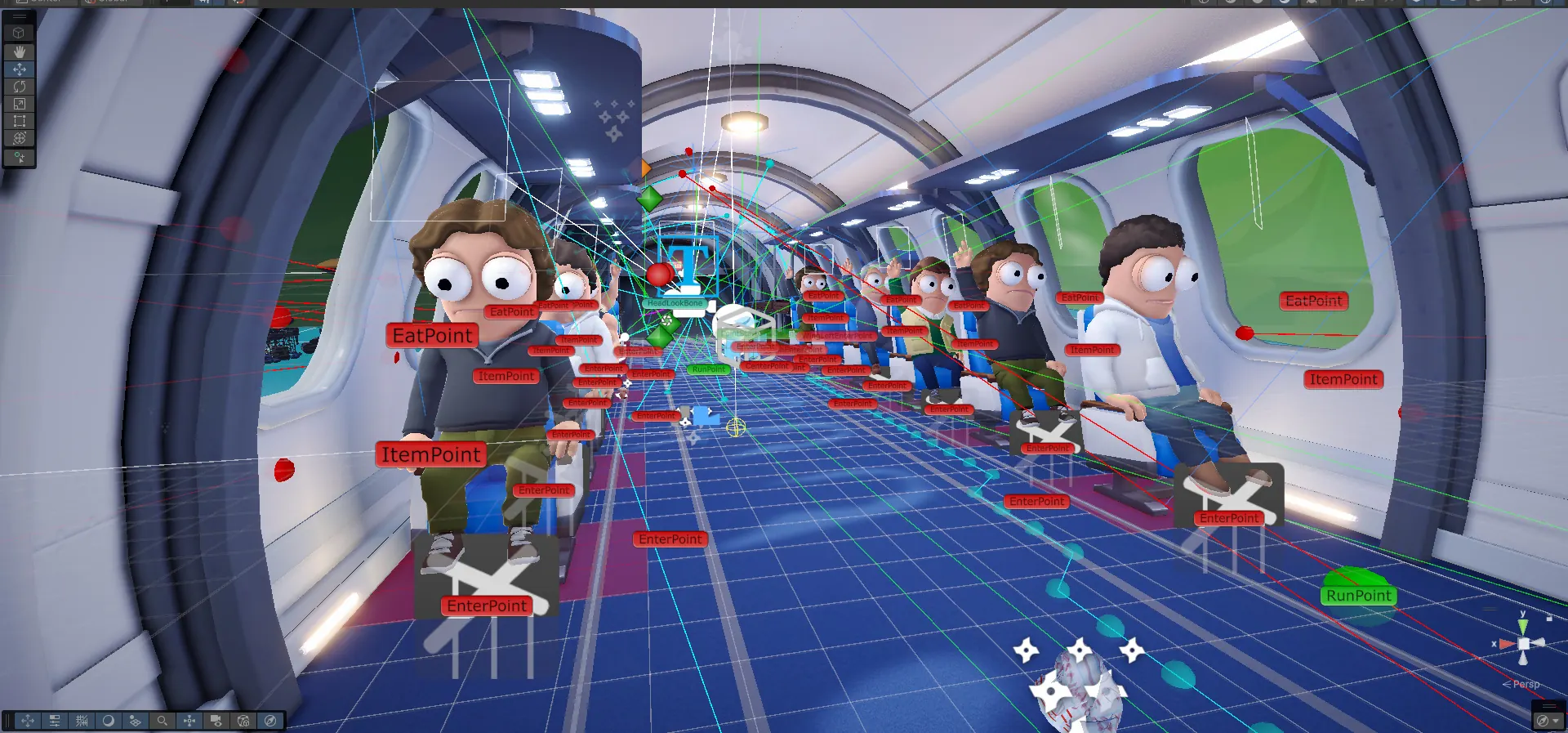
Cabin work gives Dear Passengers gameplay its broadest set of responsibilities. Official text says the crew serves passengers, keeps the cabin together, protects cargo, and handles problems before they become worse. Food and drinks matter, but service operates inside a moving physics environment where the aisle may stop behaving like a safe workspace.
Passengers are not simply background decoration. They are part of the load selected before departure, and some are described as difficult to please. Cargo also has behavior and handling risk. When the aircraft moves, unsecured travelers, luggage, service equipment, and profitable freight may become hazards that compete for the crew's attention.
Service, Containment and Emergency Priorities
A practical crew may separate routine service from emergency response, but FLEXUS has not confirmed locked classes named flight attendant, cargo specialist, medic, or engineer. Those labels can help friends organize a session; they should not be presented as a formal Dear Passengers gameplay roster. The dedicated Dear Passengers roles guide compares that distinction in detail.
The cabin is likely to reward communication because several problems can occur at once. A passenger request may be harmless until turbulence moves a cart, cargo shifts, or another traveler creates a distraction. The published premise is about stopping one problem from becoming a full disaster, so prioritization is more reliable advice than an invented list of optimal items.
Passengers, Cargo and Payouts
The manifest is a defining Dear Passengers gameplay system. Before departure, the crew chooses who and what comes aboard. FLEXUS directly links larger payouts with more trouble: some cargo is difficult to handle, some passengers are difficult to satisfy, and some flights begin going wrong before leaving the ground.
That wording confirms risk and reward, but it does not publish a passenger catalog, cargo rarity list, economy formula, contract table, or best manifest. Screenshots and trailer scenes may show memorable objects, yet a visible prop is not automatically a permanent item category with known statistics. Dear Passengers gameplay analysis should preserve that difference.
Until a playable build arrives, the safest strategy principle is balance. A new crew could avoid loading every high-risk option at once, assign someone to watch unstable cargo, and warn the pilot when the cabin cannot tolerate another sharp maneuver. These are coordination suggestions based on confirmed systems, not secret Dear Passengers gameplay rules.
Weather, Turbulence and Physics
Dynamic weather is confirmed. Steam specifically names turbulence and air pockets that can send passengers, luggage, and unsecured objects around the cabin. This means the Dear Passengers gameplay relationship between pilot and cabin is physical: the state of the aircraft changes movement, positioning, and the time available to solve ordinary tasks.
Physics also supports the comedy. A routine object can become the start of a chain reaction, and an improvised response may solve one problem while creating another. Dear Passengers gameplay appears designed to produce stories from those overlapping consequences rather than reward perfect scripted procedure every time.
The current record does not reveal a complete weather list, random-event probability, damage model, difficulty setting, or whether routes have fixed conditions. The Dear Passengers trailer breakdown labels what can actually be seen and keeps scene interpretation separate from official feature confirmation.
Solo and Online Co-op Gameplay
Steam lists both single-player and online co-op, so solo Dear Passengers gameplay is officially supported. What solo mode does with a two-location workload is not explained. FLEXUS has not announced AI coworkers, automatic piloting, simplified cabin events, instant role switching, task pausing, or separate solo difficulty rules.
Online Dear Passengers gameplay is the clearer public fantasy. One person can focus on flying while others cover cabin work. The maximum lobby size, matchmaking, invite system, join-in-progress, dedicated servers, server browser, local co-op, split screen, crossplay, and proximity voice chat remain unconfirmed. Steam's general chat notice does not define a spatial voice system.
Readers looking for mode-by-mode evidence should use the Dear Passengers player count and multiplayer guide. It tracks each open lobby question without turning trailer headcounts into a promised player limit.
Confirmed and Unconfirmed Dear Passengers Gameplay
Dear Passengers Gameplay Questions Still Waiting for Evidence
This board is the practical boundary for current Dear Passengers gameplay coverage. The confirmed features guide maintains the wider release, platform, language, input, demo, and hardware record.
Dear Passengers Gameplay FAQ
These answers reflect official material checked on August 4, 2026. Dear Passengers gameplay may become more specific when FLEXUS publishes the promised actual-flight video, a public demo, longer uncut footage, or a launch manual.
Official material establishes a broad loop: choose passengers and cargo before takeoff, divide cockpit and cabin work, deliver passenger service, protect the load, react to weather and physics problems, and try to reach the destination. FLEXUS has not yet published scoring, progression, route length, or failure rules.
Yes. Piloting is a confirmed part of Dear Passengers gameplay, and FLEXUS stated on July 31 that players fully control the plane. The developer has not yet documented instruments, takeoff steps, landing inputs, autopilot, or flight-model realism.
Cabin players serve food and drinks, manage passengers, protect cargo, keep problems from escalating, and react when turbulence or air pockets move people and loose objects. A formal class roster, inventory system, and complete tool list have not been announced.
Yes. Steam lists single-player as a supported mode. FLEXUS has not explained how solo Dear Passengers gameplay handles cockpit and cabin duties, so AI crew, role switching, automation, pausing, and difficulty adjustments remain unconfirmed.
FLEXUS and Steam classify Dear Passengers as an action, adventure, and indie game. Flying is real gameplay, but the public pitch emphasizes social cooperation, physical comedy, difficult passengers, risky cargo, and cascading emergencies rather than verified simulator-level procedures.
FLEXUS confirms that players fully control the plane, but no complete input list is public. Pages that assign specific keyboard, controller, throttle, landing-gear, or emergency inputs are speculating unless they cite a playable build or a new FLEXUS control guide.